
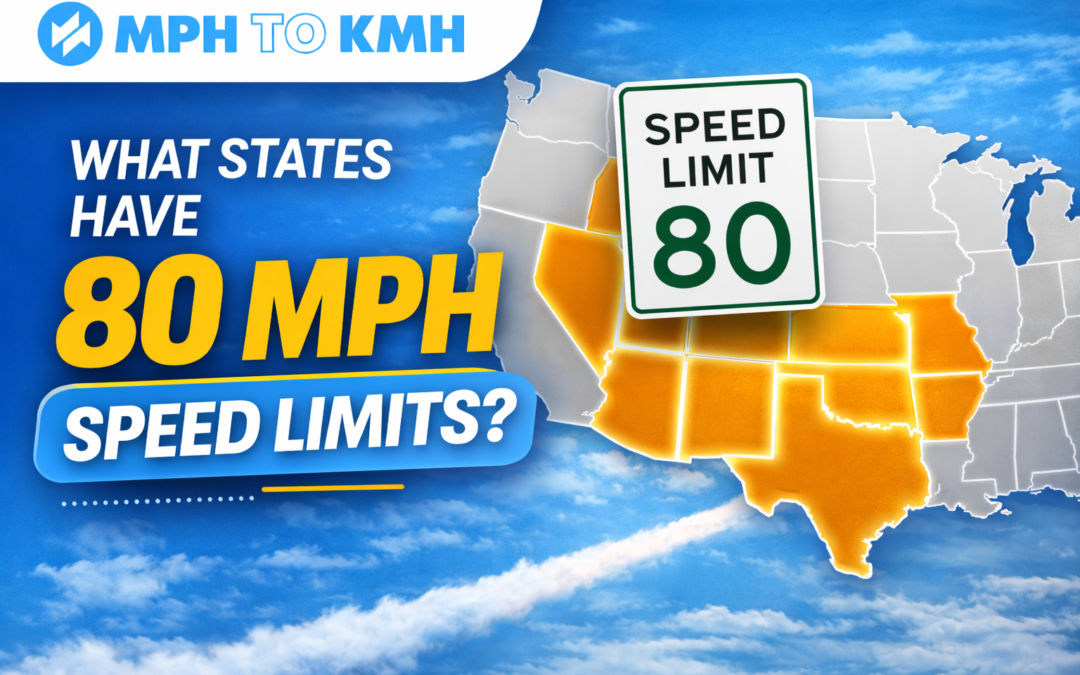
If you have ever driven across wide-open highways in the West, you may have wondered what states have 80 MPH speed limits and where those higher limits legally apply. Speed laws in the United States vary by state and by roadway type, which means the answer depends on rural interstates rather than city streets.
In this guide, you will see exactly which states allow 80 MPH, how Texas reaches 85 MPH, and what these limits mean for your everyday driving decisions.
Why 80 MPH Speed Limits Exist on Certain Highways
You need to understand that 80 MPH limits are almost always posted on rural interstate highways with long sightlines and low traffic density. State transportation agencies conduct engineering and traffic studies before raising limits, focusing on road design, crash data, and average travel speeds. When conditions support safe higher speeds, lawmakers approve increases that reflect how drivers already use those roads.
Most 80 MPH states are located in the Great Plains and Mountain West, where population density is lower and highways stretch for hundreds of miles. These regions typically experience less congestion than urban corridors in the Northeast or West Coast. As a result, policymakers argue that higher limits can balance travel efficiency with safety standards when infrastructure supports it.
What States Have 80 MPH Speed Limits Right Now
As of 2026, nine states allow 80 MPH on at least one stretch of rural interstate. You will find these higher limits in Idaho, Montana, Nevada, North Dakota, Oklahoma, South Dakota, Texas, Utah, and Wyoming. In most cases, the 80 MPH maximum applies only to specific rural freeway segments rather than statewide across every highway.
Some states differentiate between passenger vehicles and heavy trucks, often setting truck limits at 70 MPH while cars may travel at 80 MPH. This vehicle-based distinction reflects braking distance and weight considerations that affect stopping ability at high speeds. When you drive in these states, posted signs always control, even if another road in the same state has a different maximum.
Texas and the 85 MPH Exception
Texas stands apart because it allows the highest posted speed limit in the United States at 85 MPH on a segment of State Highway 130. That toll road was designed with modern engineering standards and approved through a formal traffic and safety study before the higher limit was implemented. While Texas permits 80 MPH on many rural interstates, the 85 MPH stretch remains unique nationwide.
You should not assume every Texas highway carries that limit, since urban interstates and other roads often have lower caps. Even within West Texas, some corridors remain at 75 or 80 MPH depending on local conditions. The 85 MPH designation demonstrates how state authority after 1995 gave transportation departments flexibility in setting appropriate maximums.
How the 55 MPH Era Shaped Modern Speed Laws
Before you evaluate what states have 80 MPH speed limits, you should understand the national 55 MPH era that began in 1974. In response to the oil crisis, Congress tied federal highway funding to compliance with a nationwide maximum, creating uniformity across all states. That law remained in effect until it was gradually relaxed and fully repealed in 1995, returning control to individual states.
After repeal, many Western states reassessed rural interstate limits and raised them to 70, 75, and eventually 80 MPH. Legislators argued that improved vehicle safety features and modern highway design justified these increases. Today’s patchwork of limits reflects that shift from federal oversight to state-based decision-making.
Regional Patterns in 80 MPH States
You will notice a clear geographic pattern among states that post 80 MPH limits. Most are located in wide, sparsely populated regions with long rural corridors and relatively straight road alignments. By contrast, densely populated states in the Northeast typically cap rural interstates at 65 or 70 MPH.
Climate and terrain also influence these differences, since heavy snowfall, frequent rain, and mountainous curves can reduce safe operating speeds. Transportation officials weigh these factors when recommending changes to statutory limits. The result is a regional divide that reflects infrastructure realities rather than arbitrary policymaking.
Rural vs Urban Interstate Limits
When researching what states have 80 MPH speed limits, you must distinguish between rural and urban freeways. Rural interstates often qualify for higher caps due to lower congestion and fewer entry and exit ramps. Urban interstates, even in 80 MPH states, frequently remain at 60 to 70 MPH to manage traffic density.
Residential and city streets rarely exceed 35 MPH, reinforcing that the 80 MPH designation is highly location-specific. Speed laws are structured in tiers that reflect risk levels across different road types. Understanding these categories helps you interpret statewide charts more accurately.
Vehicle Type Rules at High Speeds
Several 80 MPH states impose lower maximums for large commercial vehicles. For example, passenger cars may legally travel at 80 MPH while semi-trucks are limited to 70 MPH on the same roadway. This separation acknowledges the longer stopping distances and rollover risks associated with heavy trucks.
If you drive a personal vehicle, you still share the road with trucks subject to different legal thresholds. That difference can create varied traffic flow patterns on rural highways. You should remain attentive to posted signage that clarifies vehicle-specific rules.
Converting 80 MPH for International Context
If you compare U.S. limits with countries that use the metric system, you may want a precise conversion. An 80 MPH limit equals approximately 129 KMH, which you can calculate quickly using the MPH to KMH converter when planning cross-border travel or analyzing data. Accurate conversions help you interpret international speed discussions without confusion.
Metric comparisons also reveal that many European motorways operate at similar or higher limits depending on local law. While Germany famously has unrestricted Autobahn sections, most nations still impose structured caps. Converting units ensures you evaluate those differences fairly.
Common Questions About Driving Slightly Over
Drivers often wonder how strictly officers enforce posted limits, especially in states with high maximums. The legal standard remains the posted speed, and exceeding it can result in citations regardless of informal driving culture. If you have asked yourself whether small margins are tolerated, the discussion in can you go 5 over the speed limit explains enforcement realities and why discretion varies.
Even in 80 MPH states, enforcement policies can differ by county or highway patrol division. Courts ultimately rely on statutory language rather than unwritten practices. Staying within posted limits protects you from fines and insurance increases.
Metric vs Imperial Speed Systems
When you analyze speed laws internationally, you also encounter questions about measurement systems. In the United States, MPH reflects the imperial system, which differs from the metric units used in most countries. A clear explanation of this distinction appears in is mph metric or imperial, helping you understand why American road signs differ from global standards.
That measurement difference does not change the underlying safety principles guiding limit decisions. Engineers focus on reaction time, vehicle dynamics, and road geometry regardless of unit type. However, knowing the system clarifies how U.S. policies align with international benchmarks.
Safety Statistics and Practical Considerations
Higher speed limits can reduce travel time across vast rural regions, but they also increase crash severity due to greater kinetic energy. Federal data consistently shows that speed contributes to a significant percentage of fatal crashes each year. Policymakers must weigh economic efficiency against public safety when adjusting maximums.
You should also remember that weather, construction zones, and traffic conditions can justify driving below the posted maximum. Even where 80 MPH is legal, prudent driving means adjusting to visibility and roadway hazards. Safe operation depends on judgment, not simply the number on the sign.
Conclusion
When you ask what states have 80 MPH speed limits, the answer points you toward nine primarily Western and Plains states that permit that maximum on selected rural interstates. Texas goes further with an 85 MPH toll road, illustrating how state authority allows tailored decisions based on engineering studies.
As you travel across the country, understanding these distinctions helps you comply with local law, interpret speed charts accurately, and make informed, safety-focused driving choices.
Ultimately, speed limits reflect a balance between mobility and protection, shaped by geography, infrastructure, and policy history. You benefit from knowing not only which states allow 80 MPH, but also why those limits exist and where they apply. By combining legal awareness with responsible driving habits, you can navigate America’s highways confidently and lawfully.